
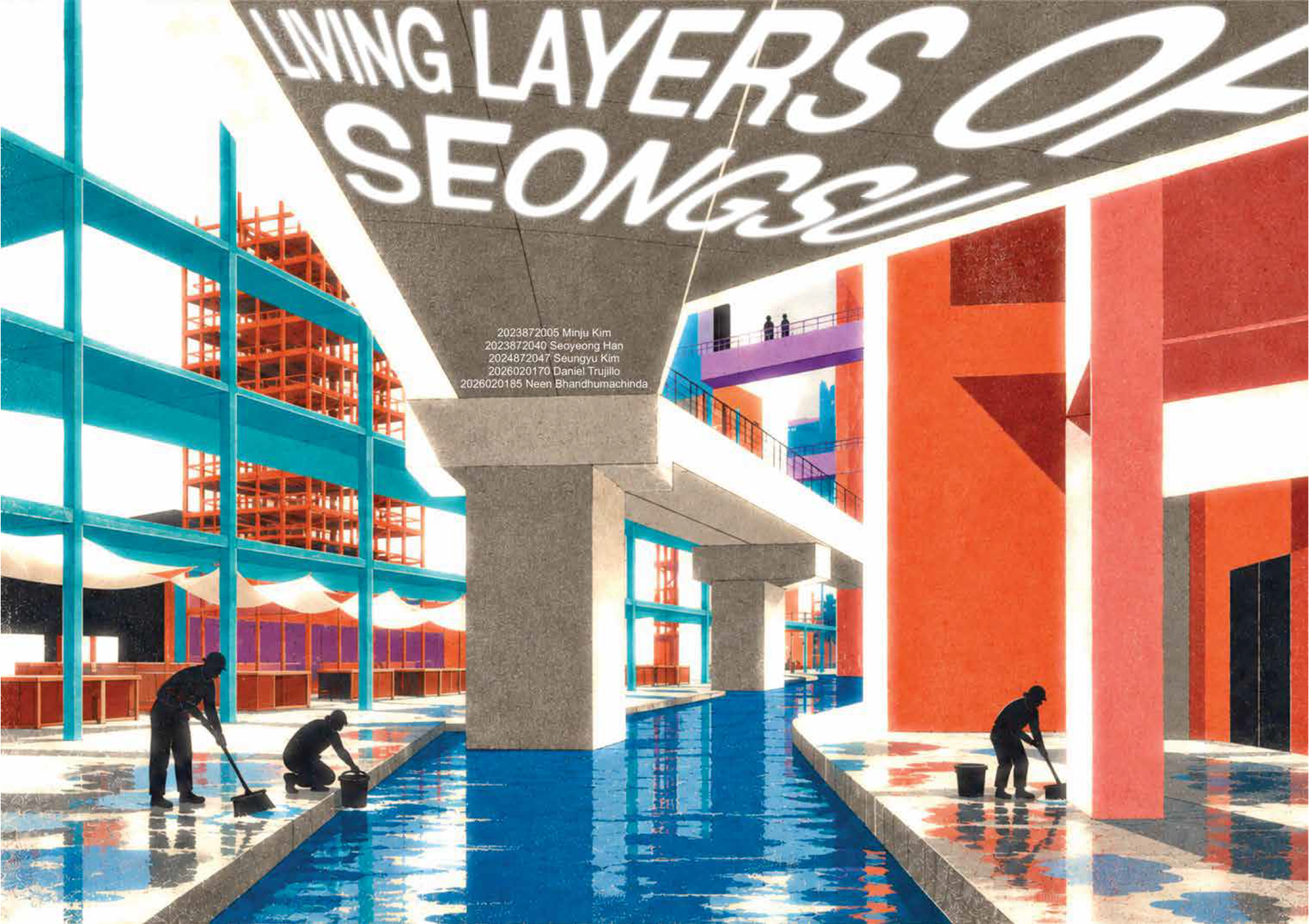
LIVING LAYERS OF SEONGSU
- MinJu Kim, SeoYeong Han, SeungYu Kim, Daniel Trujillo, Neen Bhandhumachinda
Diagnosis of the Study Area
Trigger
- Disaster: Land value & development; Population increase; Climate change
- What if: What if the ground itself were reshaped to control and redirect water flows?;
What if climate change forced people to build new spaces themselves around existing buildings?
Scenario
Timeline & Rules (2026-2075)
Strategy 01_Preserve the Stock
Building Type Analysis for Reusing Existing Structures: Villa; Apartment; Hanok
Targeting Poor Condition Buildings in Low Areas
Rules & Application: Preserve the Stock (2050, 2075)
Building Material Circulation (2050, 2075)
Strategy 02_Productive Mix
Mapping Electricity Demand for Future
Mapping Amount of Solar Irradiation for Future
Imbalanced Market Distribution
Urban Farms in Seongsu
Rules & Application: Productive Mix (2050, 2075)
Strategies for Producing Energy (2050, 2075)
Urban Food Production Network (2050, 2075)
Strategy 03_Multivalent Landscape
Han River Flooding and Low Areas
Targeting Poor Condition Buildings in Low Areas
Rules & Application: Multivalent Landscape (2050, 2075)
Flood-Adaptive Urban Network (2050, 2075)
Strategy 04_Adaptive Infill
Street Analysis for Walkways
Open Space Analysis for Infill
Building Height Analysis for Infill
Rules & Application: Adaptive Infill (2050, 2075)
Case Studies & Application
Case Study: La Muralla Roja (Ricardo Bofill)
- Modifications
- Applications
Case Study: Pasadena Heights (Kiyonori Kikutake)
- Modifications
- Applications
Case Study: Walden 7 (Ricardo Bofill)
- Modifications
- Applications
Case Studies Applied to the Study Area
Study Area_After Strategies Application
Surviving Floods through Rule Application
Urban Plan: 2050, 2075
Urban Section A-A': 2050, 2075
Results of Strategies Implementation
Cluster Boundaries
Example: The Civic Basin
Physical Model: 2050
Physical Model: 2075

Copyright © uosarch.ac.kr., Some rights reserved.