
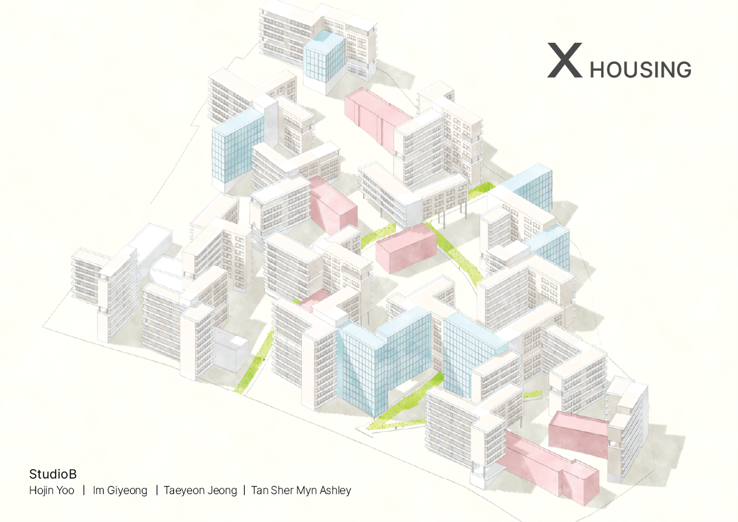
X Housing is all in one urban strategy.
It integrates housing, open space, and community programs into one connected system.
Green path and community spaces link the blocks, while housing diversity is ensured by modules.
It transforms our site into a shared and active neighborhood.
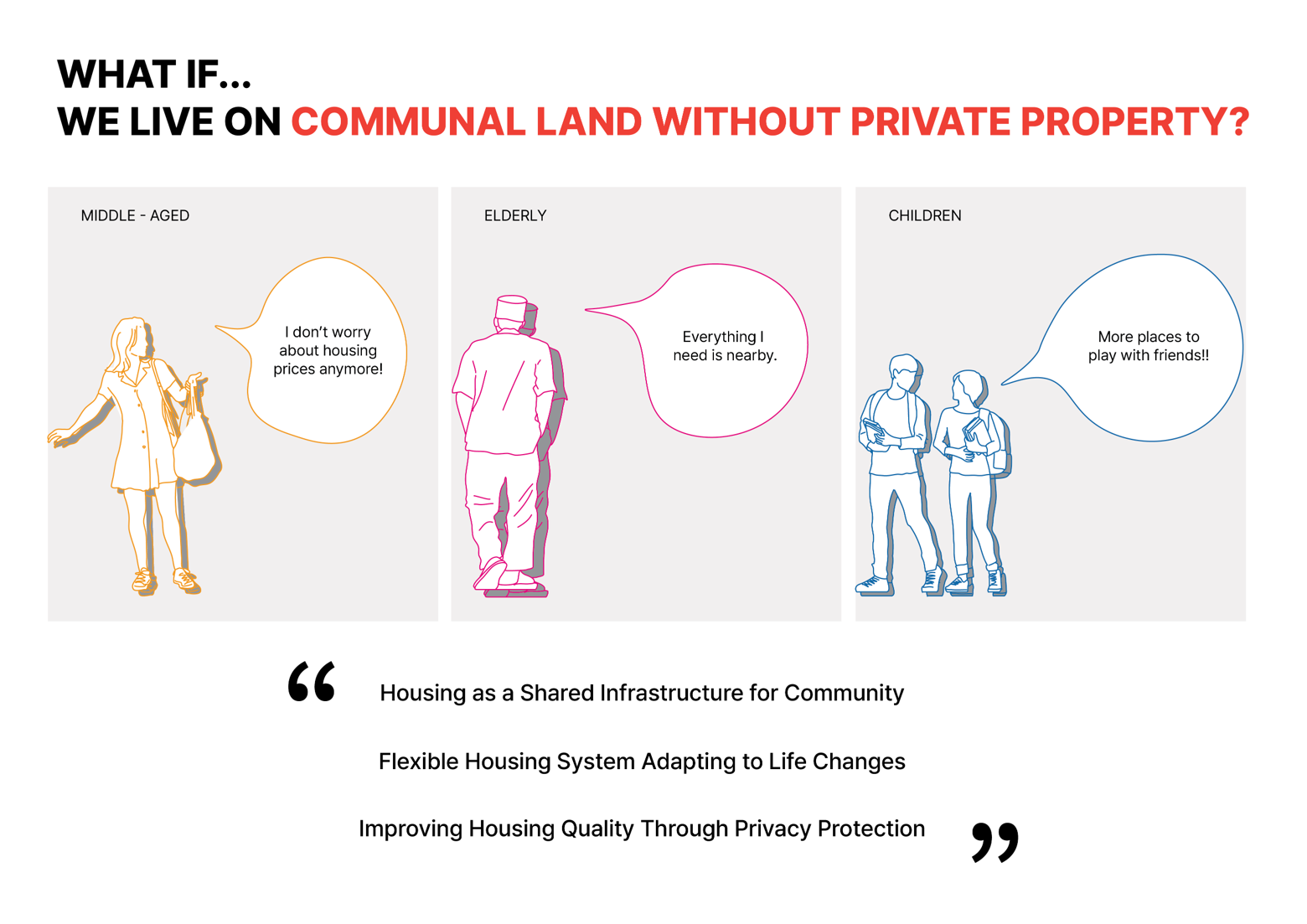
We worked on the scenario that the private ownership of real estate has disappeared and reestablished as a public resource. These personas point out living quality rather than economic value.
We came up with these three design agendas to enable permanent residence and ideal community.
1) Even though there are many open spaces around the site, such as small parks and green areas, people cannot reach them easily. There is no clear pedestrian flow that connects the site to those spaces. As a result, residents feel isolated from the larger network of public space, and the site itself provides no alternative.
2) Most buildings within the site are used only for housing, with little variation in program. There are no community facilities, no commercial functions and no shared spaces. This lack of usage diversity means social interaction between residents remains very limited.
3) Many parts of the site look like open space but actually, they don’t serve any effective purpose. These include privately owned areas that remain accessible, or leftover land around buildings. People can enter them, but since they lack any function, they are eventually wasted.
4) The site's slope shapes circulation and access throughout the area and defines the street hierarchy. We confirmed that the most important main road was located in the valley cutting across the center of the site, and our team decided to preserve this road to maintain existing flow.
CASE STUDY
1) Eastwood Apartments in Roosevelt Island. It shows how housing can integrate public functions. It uses step-down massing for clear views, courtyard-centered open space, distributed facilities, and sky corridors to link levels.
2) Habitat 67. It can accommodate various housing types through the combination of basic units. It shows how the modular system works for providing private open spaces. At a larger scale, the V-shaped layout creates larger communal spaces in between.
3) Halen Housing. We learned about the appropriate arrangement of public
space and private space utilizing the topography. Since our site has steep slope, we considered
residents' interaction and privacy on the ground floor within the lesson that we got from this case
study.
4) Shinonome Canal Court Caden in Tokyo. It uses shared void spaces to create settings for social
interaction within the housing blocks. Its communal ground floor with shops and amenities anchors
daily life, complemented by open plazas that support gatherings and communal activities.
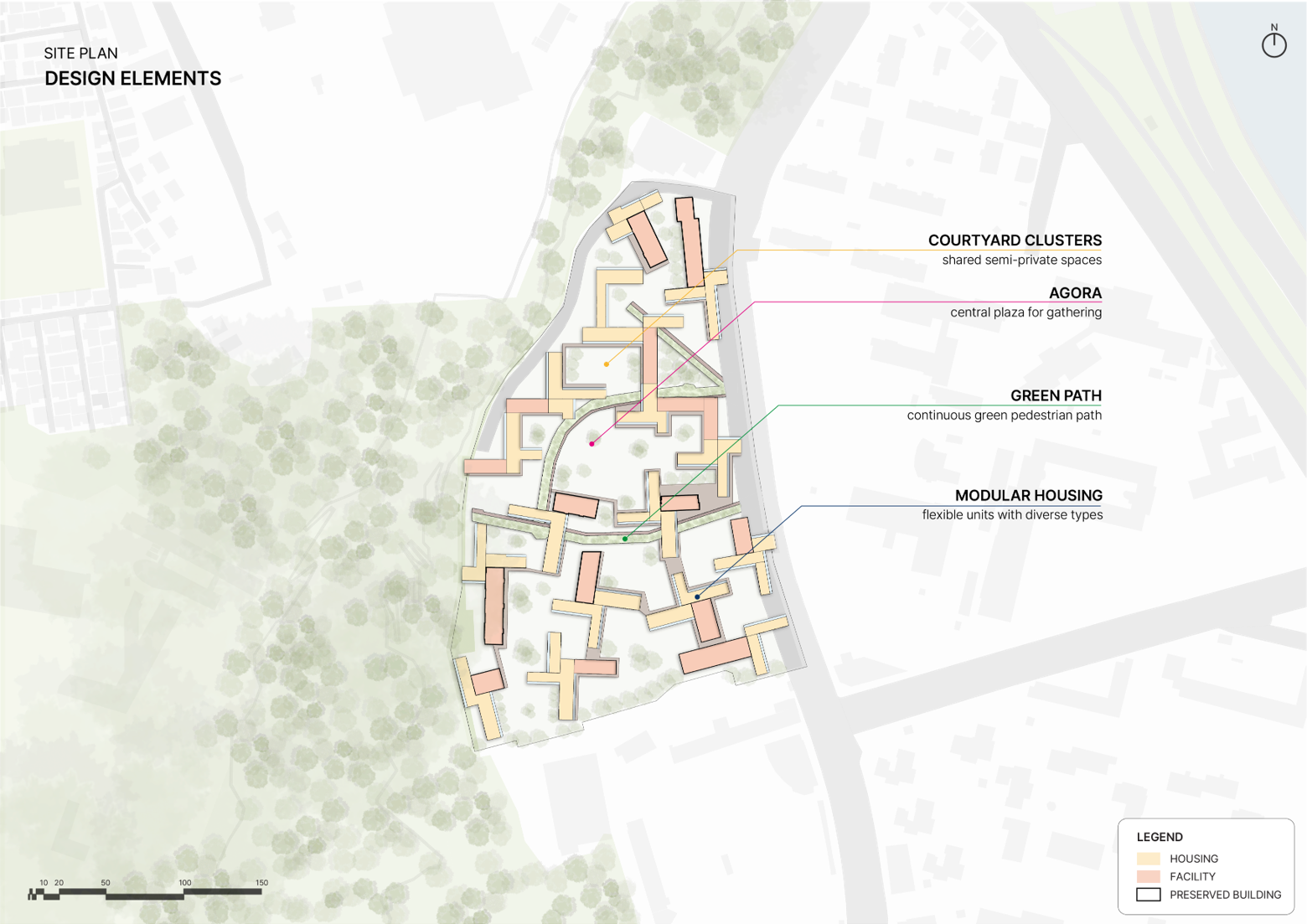
Our plan is shaped by five design elements. The Agora is the central plaza and green path forms the pedestrian path.
Module system brings flexibility and courtyard clusters made by module connection provide shared spaces.
Lastly, Stepped forms enables to be adapted on the topography.

We preserved 12 existing buildings that overlap with the new urban strategy. Since residents typically prefer new housing, the renovated buildings are used as facilities.
These two types show the presence of an envelope, depending on whether a facility contains one or two buildings.
These opens spaces are formed by the arrangement of modules. They ensure various activity by community space such as agora and courtyards for each housing units. They can resolve isolated impression of our site and connect fragmented open spaces around the site.
This diagram illustrates the seamless connectivity between the green path and the open plaza at eye level. It highlights how pedestrians experience a fluid transition between walkways and open public spaces, enhancing walkability and spatial integration within the site.
To make the open spaces more actively and safely usable, overall vehicular circulation was positioned along the edges. The western part is designed to go underground, allowing people to reach Baebong mountain directly via the green path.
This scene illustrates how the green path and open plazas function as soft “barriers” between residential units. It provides a sense of privacy that we pursue through design agenda while maintaining visual openness and accessibility within the landscape.

A module functions as a key node for residents. Three types of households are appropriately arranged around a core. Each courtyard will be a space for residents to communicate, closest to their houses. Water is collected via storage tanks located in each courtyard and reused as greywater.
We intended 2types of pedestrian path, one on the ground and one in the building. Each building has a void to ensure outdoor access on the upper floors. The network connecting these voids creates new pedestrian paths and resident communication spaces that are independent of the topography.
This section showcases how the site’s expansive greenery acts as a natural extension of Baebong Mountain, seamlessly blending the landscape into the urban fabric. A green path provides circulation that connects key spaces while enhancing accessibility and cohesion.
We divided the implementation plan into three phases. Each phase includes process of residents in and out and construction for core and housing. We can afford temporary housing for residents nearby our site because we are working with modules and we supposed scenario of communal land.

Copyright © uosarch.ac.kr., Some rights reserved.