
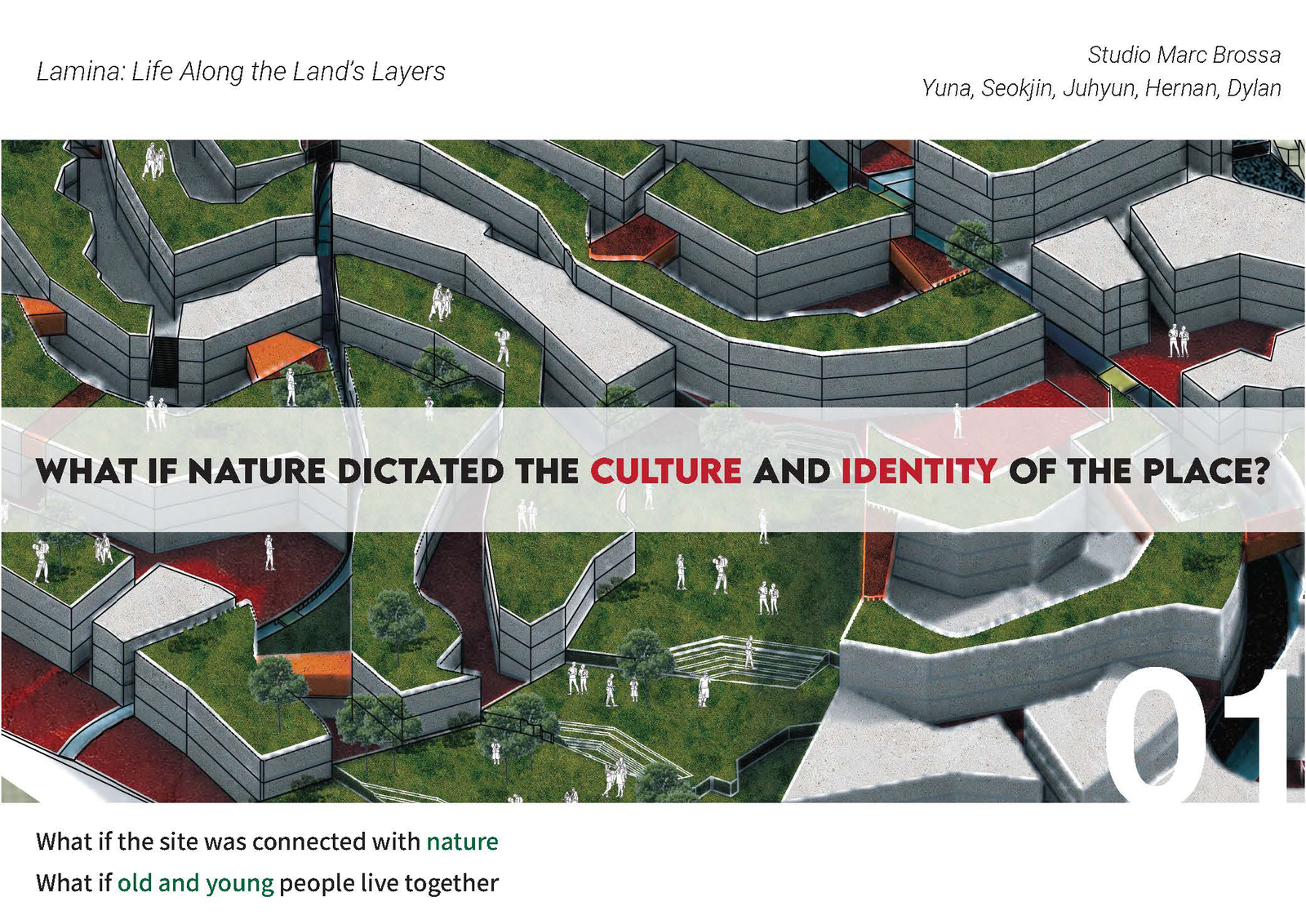
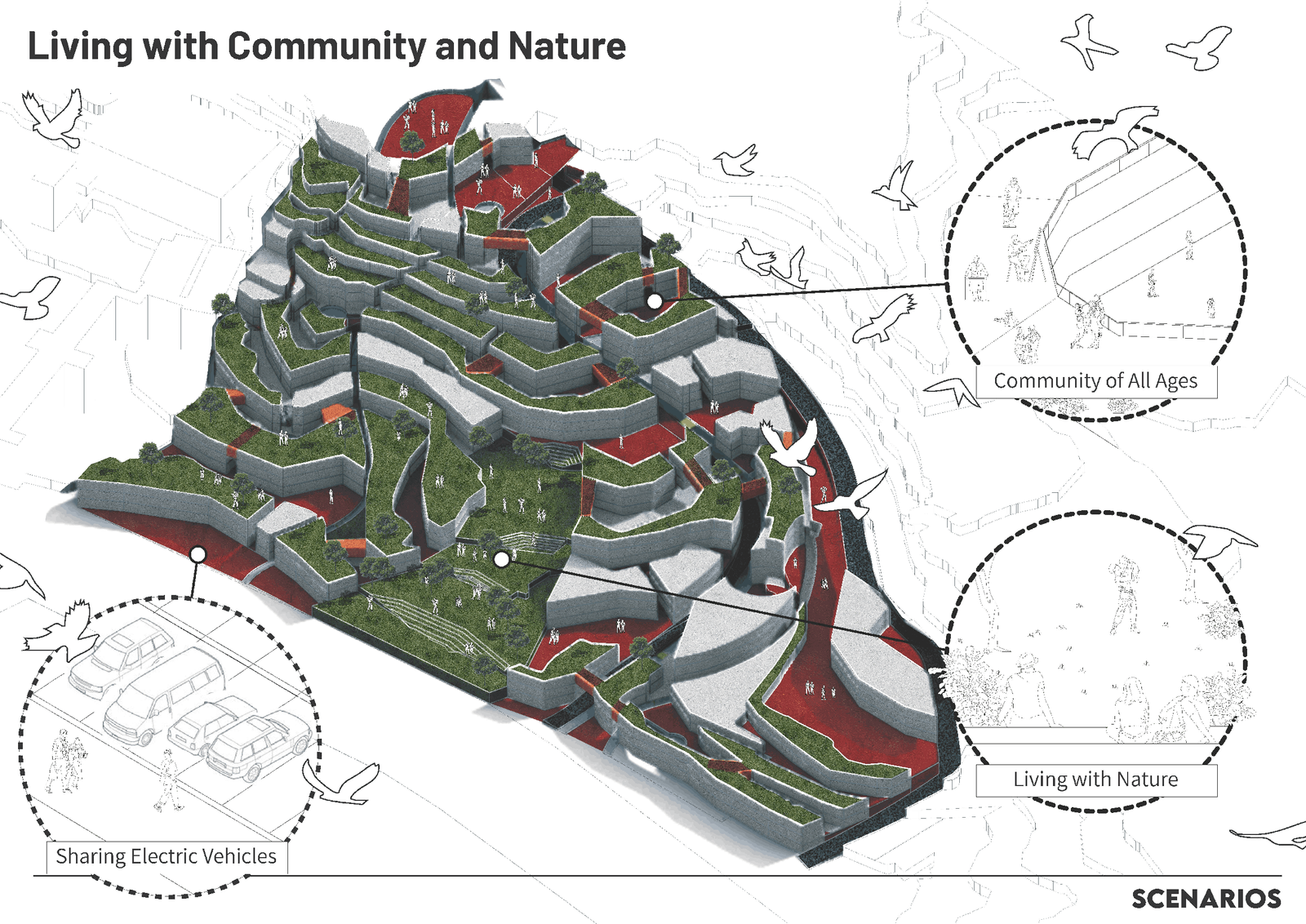
This is an imagination of how we want to challenge the current way of living. We want to imagine that in the future we will have a greener and more interconnected place to live where residents share electric cars, live together with nature and share a community with people of all ages.
First image is section collage, referencing the strategies of Rokko Housing and Halen Housing,illustrates a stepped arrangement of buildings along the sloping terrain. Such anarrangement connects the buildings, creating continuous platforms where residents can move, interact, and share communal life.
Second section collage highlights the sense of openness created by the central open space in relation to the backdrop of Baebongsan. The shared spaces between buildings visually connect with the natural landscape, allowing residents to experience a continuousopenness where daily life and nature blend seamlessly.
Our goals in creating is as follows: to unite the older and younger generations through shared spaces, to bring nature and the city together through streams and parks, and to realize a five-minute city where living, cultural activities, and working are all possible within one district.
The pond derived from the water stream creates a small plaza within the cluster area. This space is adjacent to many buildings, allowing numerous residents to gather and engage in various interactions.
Second image shows a park built on a slope. More than just a place to rest, it serves as a vibrant open space that connects community members. The terraced structure creates a perfect setting for people to gather, sit, or simply stroll, encouraging natural interaction.
We found important factors such as the aging population climate change and the want for more efficient lifestyle. the site give us both oppurtunities and challenegs , while the location is great it still lacks accessibility, community life and basic amentities.
Roads that ensure efficient external connectivity become the most active and vibrant routes, while those that are highly disconnected from the outside grow increasingly private and quiet.
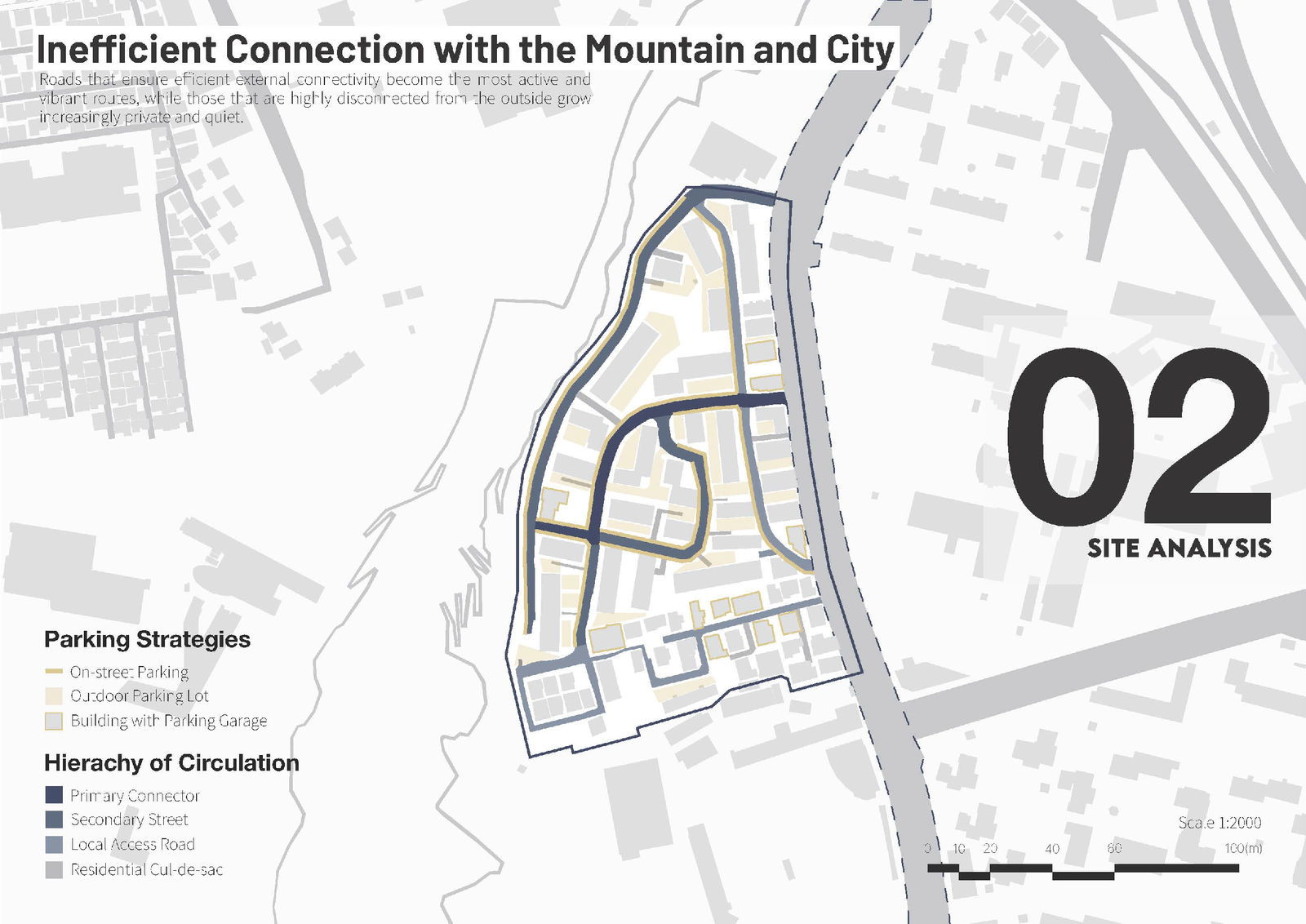
The area has two main building types: small houses that are tightly packed and dense, and larger buildings that leave bigger open spaces. Small houses follow a clearer street direction, while larger ones are shaped more by the land's terrain.
The site contains very few open spaces and amenities, highlighting a lack of everyday facilities. From this, we set the goal of creating a "5-minute city" where all essential services are within walking distance. At the same time, the site serves as an important access path to the mountain.
The drainage patterns inferred from the site's contours align closely with the existing paths, suggesting that current circulation routes follow the natural terrain.
This analysis was built using a system. We tracked every doorway, carpark, road, building and more and then we drew lines to show how the spaces were connected. When a few buildings share the same connection we drew a circle to show that they are a cluster.
Here, we started to draw which areas were more private and created a privacy map. An interesting thing we learnt was that from the interviews, locals used the center road however in this diagram the same road is seen as more private. So we realized that locals and visitors were able to use the space differently.
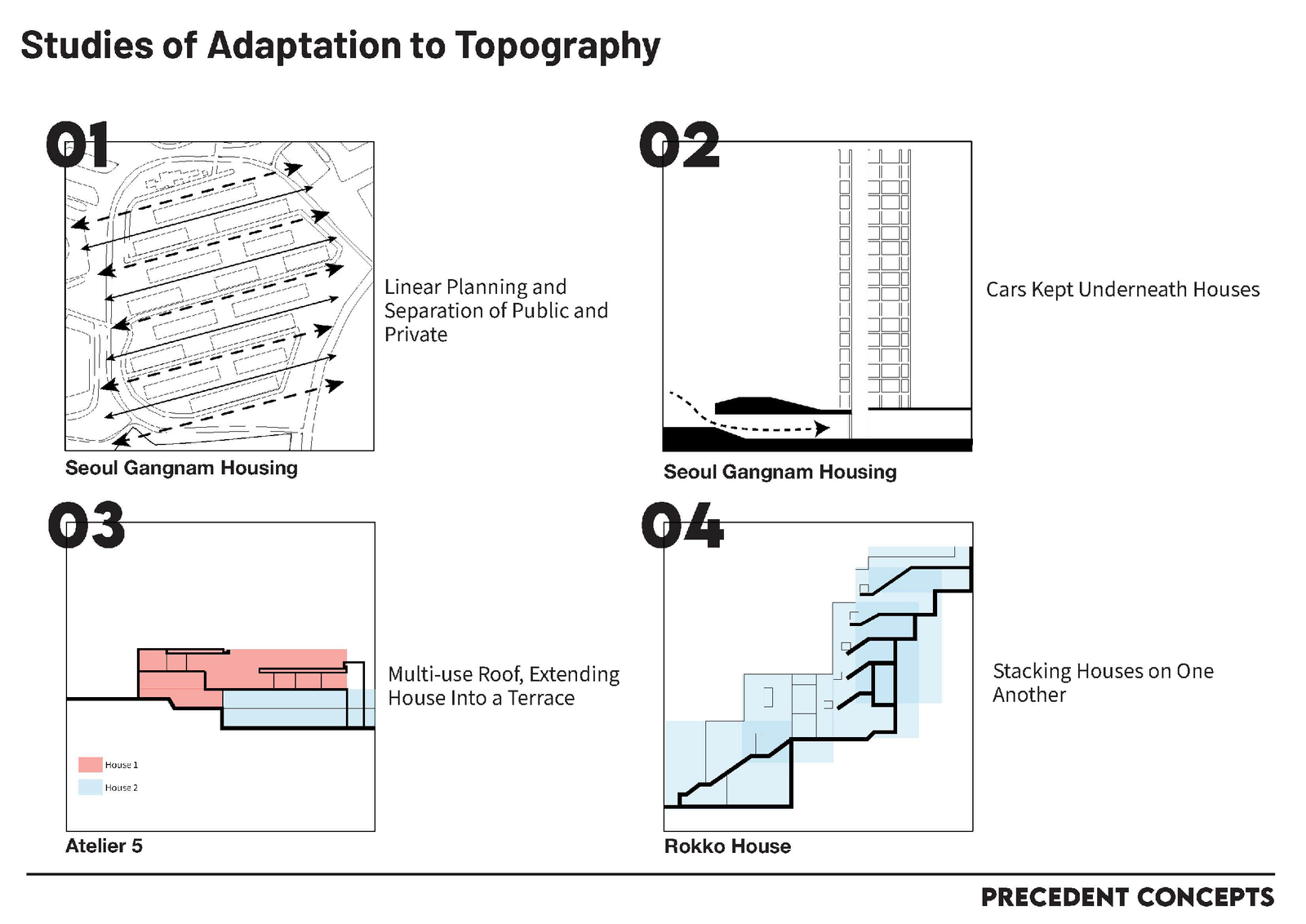
We studied case studies to see how housing adapts to topography. From Gangnam Housing, we learned to place houses along contour lines and keep cars underneath. Atelier 5 showed us that roofs can serve as balconies, and from Rokko Housing, we saw how houses can be stacked on top of each other.
From our studies, we learned to use the site's topography. We used the valleys to reveal water channels and a main road, arranged the buildings along contour lines, formed pedestrian paths between them, and created open spaces in the leftover areas.
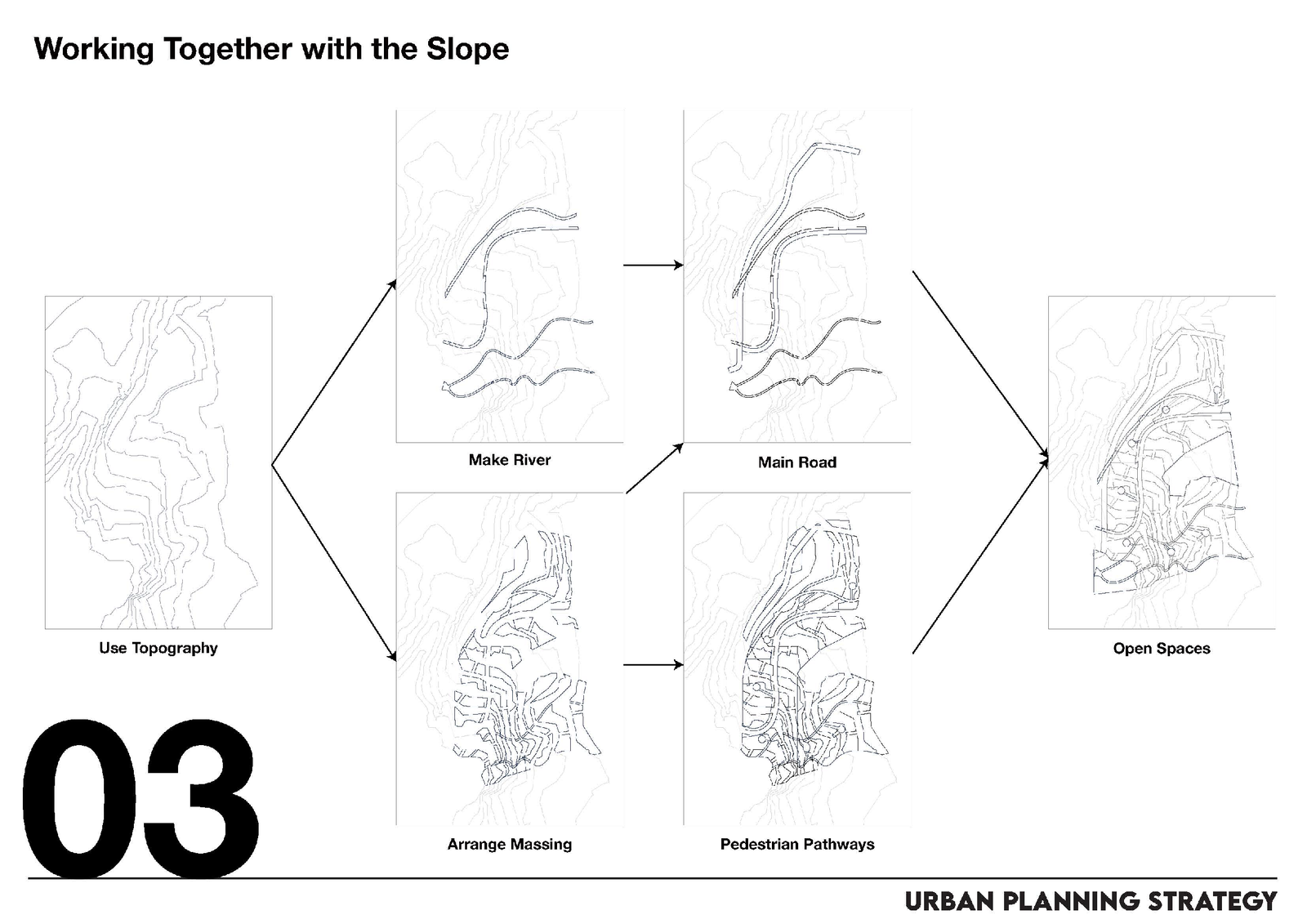
Buildings are arranged along the contour line and naturally, the pedestrian paths followed too. The water channels run through the entire site connecting nature and city. We then used the river and buildings as a grid to find the best places to make our clusters.
The massing is organized into two main typologies, inspired by Rokko and Halen Housing. On steeper areas, the houses stack, while gentler slopes open up more space. Rooftop sky bridges connect the buildings, creating circulation and enhancing shared spaces.
Third image shows the boundaries of each cluster. Each one is centered around a pond, creating shared open spaces and a central gathering point. The pond connects back to the water channel and provides more opportunities for community interaction.
Finally, we preserved the main existing car route, while pedestrian paths naturally follow the contours between buildings. Parking is placed underground beneath the mountain-facing buildings, with additional surface parking near the external main road.

Copyright © uosarch.ac.kr., Some rights reserved.