
The main concept of my project is connection to nature.

1. Main Concept – Connection to Nature
This project is structured through four main design elements:
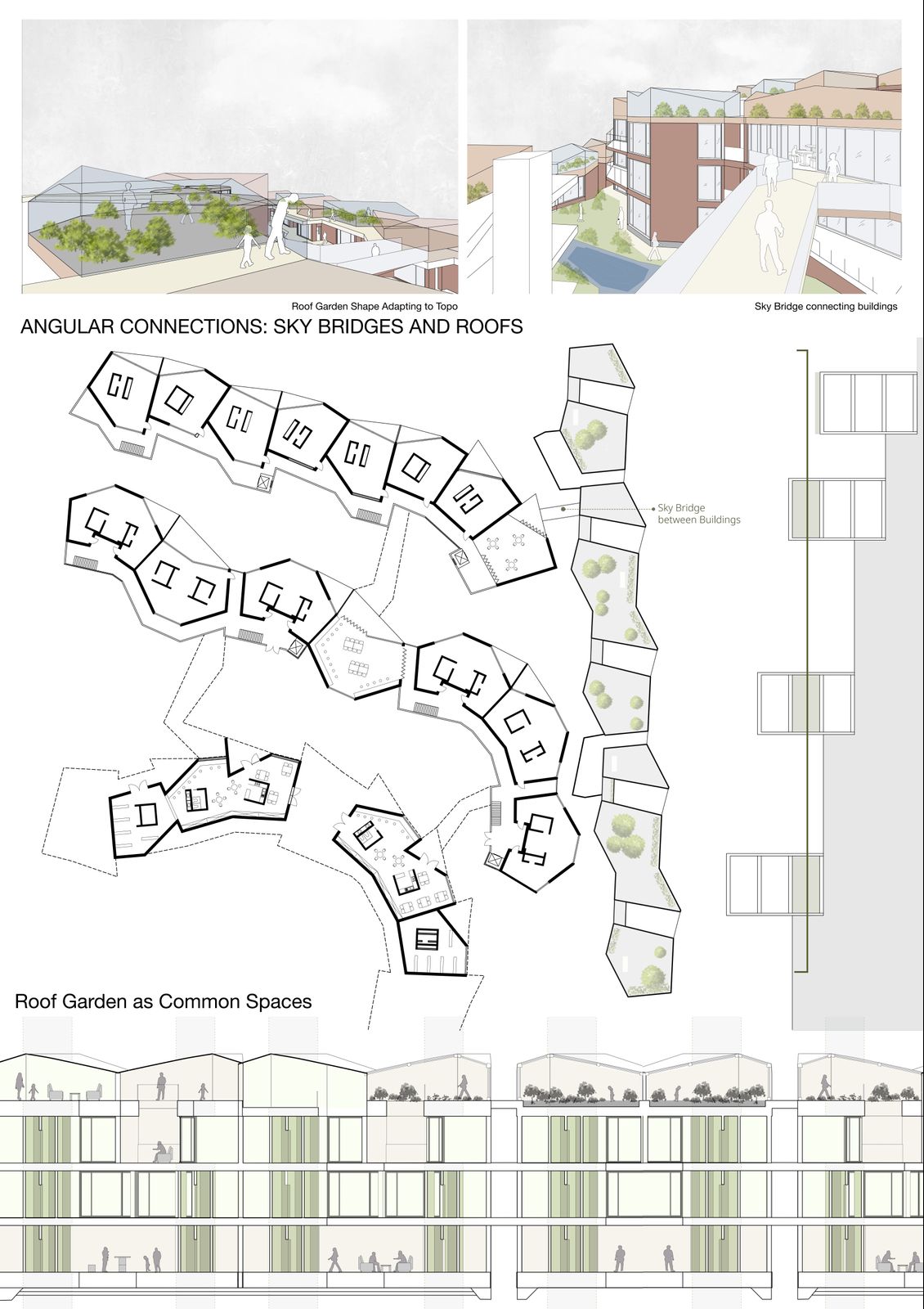
First, the sky bridges, which visually and physically connect different building masses and create moments of pause above the landscape.
Second, the pentagonal unit geometry, which allows the linear building masses to bend and adapt to the shifting topographic lines.
Third, the water system flowing down from the mountain, which creates soft boundaries and natural public zones between buildings.
And fourth, the sectional level differences, which generate layered experiences of privacy and openness while separating different programs.
2. Unit System and Spatial Flexibility
Because the topographic lines are sometimes curved and sometimes straight, the way they are combined is very important.
To avoid being restricted to only curved forms, I chose a pentagonal unit that allows the buildings to grow in multiple linear directions.
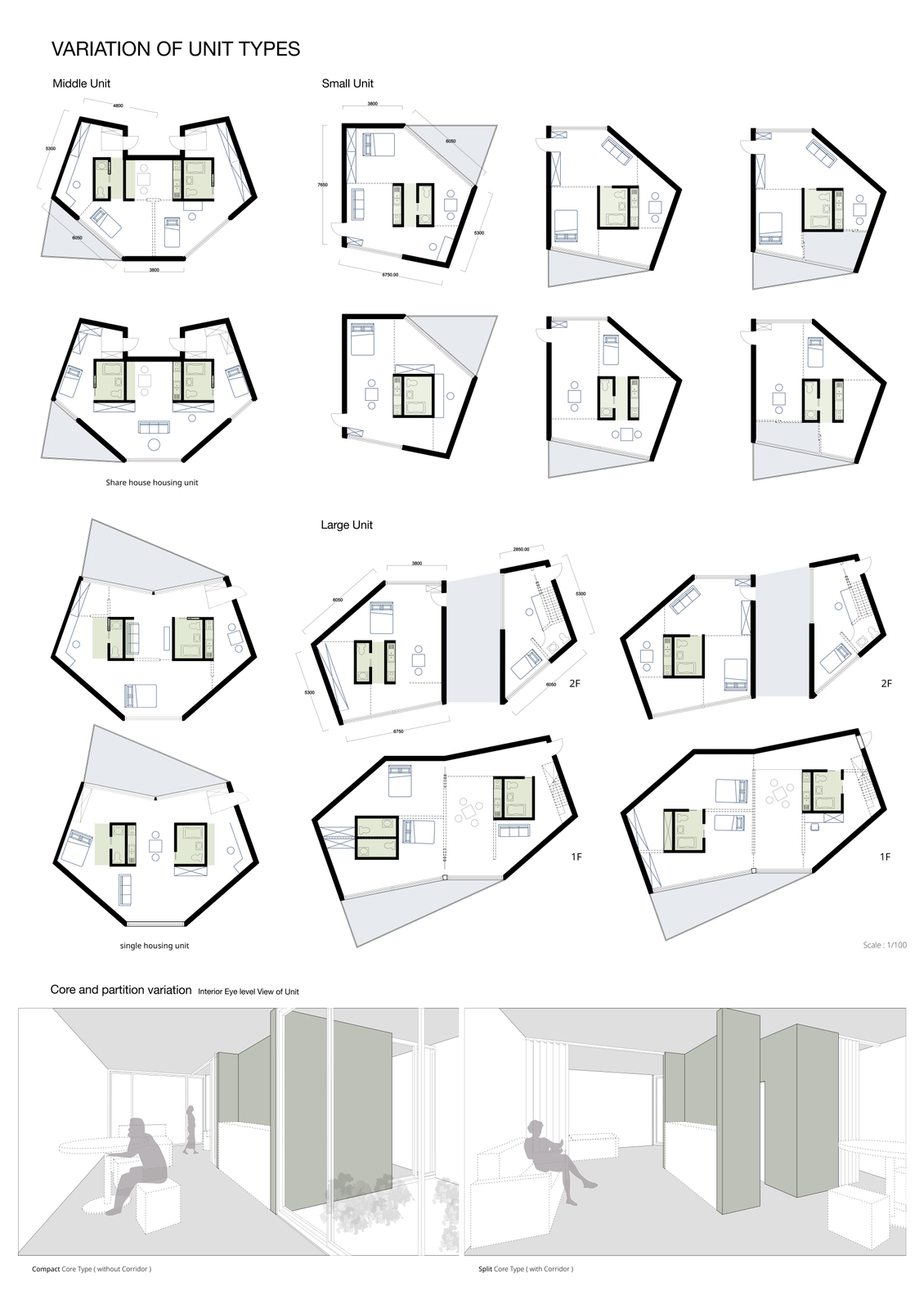
Each unit has a fixed core in the center that contains the bathroom and toilet.
Around this core, flexible partitions are used. These are not fixed walls, but movable elements such as curtains and sliding doors.
There are two core types:
One is a split-type core, which creates a small corridor in the middle.
The other is a compact core, which allows a larger bathroom space.
There are three unit sizes:
The small unit is designed for one or two people.
The medium unit is made by overlapping basic units and can work as a shared house or a small family home.
The large unit combines two basic units vertically. It has a duplex structure, and the upper level can function as an independent micro-unit.
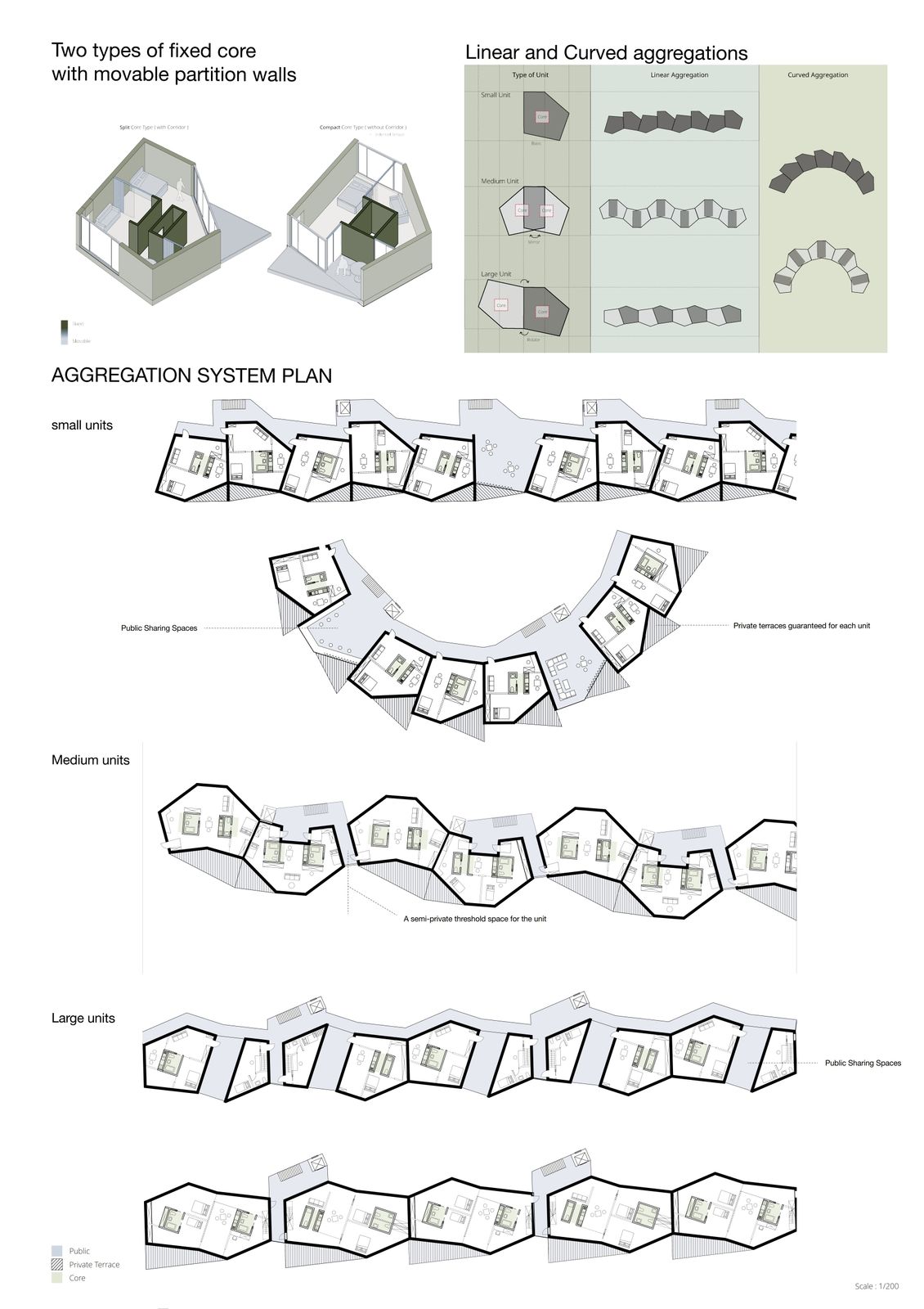
In the aggregation process, triangular terraces naturally emerge between the units.
One unit is intentionally removed in certain areas to create shared spaces, and every floor has access to at least one of these communal spaces.
These terraces are designed to frame views toward nature.

3. Site Strategy
In the site plan, I applied the same logic of sharp angles to generate paths, water channels, and green spaces.
Each building steps up with a 4-meter level difference, creating a terraced structure.
Between buildings, I placed resting spaces and ponds, so people can pause and interact.
Along the central path, on one side, people enter the ground level of the upper buildings for commercial and community programs such as a gym and a book café.
On the opposite side, people directly access the housing level by entering the second floor of the lower buildings.
The outdoor space in front of each common amenity extends the character of the interior programs into the exterior.
The water channel flows along the open ground floor level of the buildings and connects the natural landscape of Baebongsan with the urban context.
4. Roof and Sky Bridge System
The sharp geometry of the pentagonal buildings is extended into the sky bridges and roof forms, which visually and physically connect architecture and landscape.
In the large-unit aggregation building on the far right, the rooftop level becomes either an extension of the housing units or an independent public rooftop space accessible to everyone.

5. Structure and Material Strategy
The structural system is based on a timber frame structure, and timber cores also participate structurally.
The ground level uses concrete to function as a retaining wall and to protect the building from moisture.
For the building envelope, I used recycled bricks from demolished buildings on the original site.
In the axonometric drawings, I show both the sectional continuity of the cores and how people inhabit and move through the buildings in everyday life.
Thank you.
the below __ Building model 1:100 and
1:500 mass model
Portfolio

Copyright © uosarch.ac.kr., Some rights reserved.